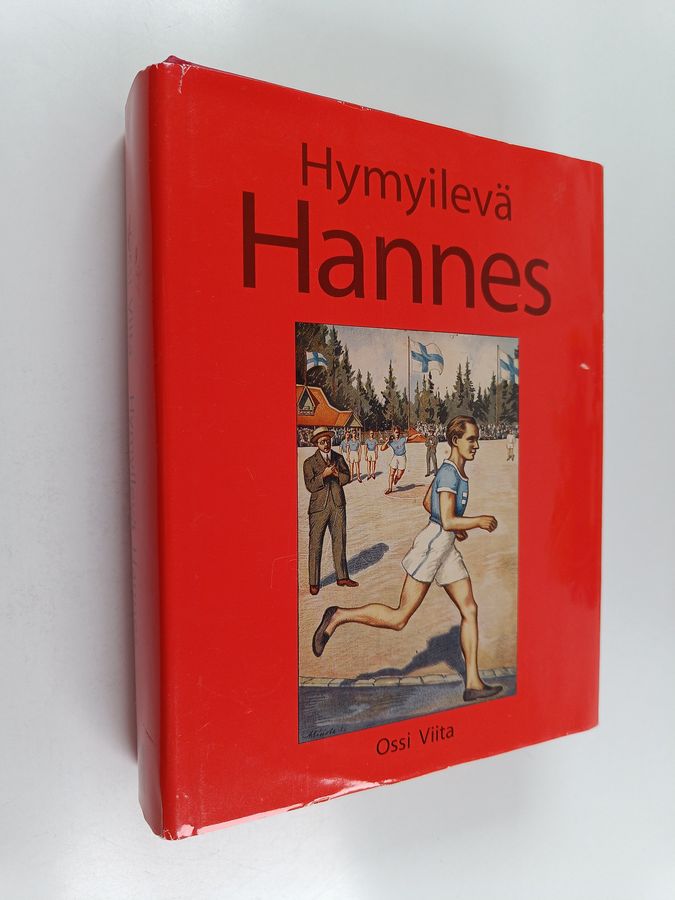
Hymyilevä Hannes
työläisurheilija Hannes Kolehmaisen sankaruus porvarillisessa Suomessa
- Kieli
- Suomi
- Julkaisuvuosi
- 2003
- Laajuus
- 471 sivua
- Muoto
- Sidottu kansipaperein (kovakantinen)

työläisurheilija Hannes Kolehmaisen sankaruus porvarillisessa Suomessa
Smiling Hannes : the heroism of working-class athlete Hannes Kolehmainen in bourgeois Finland. Hannes Kolehmainen won three gold medals and one silver medal in the Stockholm Olympic Games in 1912. Finnish working-class newspapers attempted to make him a role model for working-class youth. This was quite natural because Kolehmainen was a working-class athlete based on his background, vocation and sports club. The societal contrast was seen in the attempts to exploit his success when bourgeois newspapers started to dispel his working-class status. Hannes Kolehmainen could not, however, be effectively exploited as an exemplary hero because he travelled directly from the Olympics to Europe, and then to America to compete. The conflict was considerable. At the same time it was claimed that his victories had made Finland known around the world and had strengthened the Finnish identity. The Finnish Gymnastics and Athletics Federation (SVUL), representing the winners of the 1918 Civil War, announced that it selects only reputable Finnish citizens to the Antwerp Olympic Games. The Finnish Workers' Sports Federation (TUL) boycotted the games. Working-class athlete Hannes Kolehmainen, who won the marathon gold in Antwerp, was a hero to white Finland but a traitor to the workers. Kolehmainen's family moved back to Finland from the USA when they were awarded a 30-hectare farm in Piikkiö. The move from Piikkiö to Helsinki to become a sports equipment retailer in 1924 allowed Kolehmainen to be more effectively exploited as a role model. The temperance movement became an important target. Kolehmainen's success in two Olympics during a period of transition in Finnish history the shift from a working-class athlete to a hero of bourgeois Finland, his exploitation as an exemplary hero and the suitability of his character and deeds for a role model kept his hero's status alive for decades. The heroism was further enforced when the editors of a Finnish sports magazine (Suomen Urheilulehti) came up with the phrase 'Hannes Kolehmainen ran Finland to the world map'. The phrase was first used on 30 October 1939, when Finland was about to become involved in the 2nd World War, just 20 days after the mobilisation order. With the phrase, sport leaders created a connection between the Stockholm Olympics and the Winter War. The unifying factor was an Eastern superpower (1912 Russia, 1939 Soviet Union), against whose oppression attempts Finland had fought during the Stockholm Olympics and who was again Finland's opponent. The message of the phrase was that Finland was not alone; it would get help. After all, according to sport leaders the nation had been 'run' to world fame already in 1912. The world map -myth has strengthened the faith of Finns in elite sport, especially in times of poor success. When you combine that myth with the famous characterisation that describes Kolehmainen's person, 'smiling Hannes', you get the two phrases that Hannes Kolehmainen is still remembered for today.
2 aktiivista tarjousta